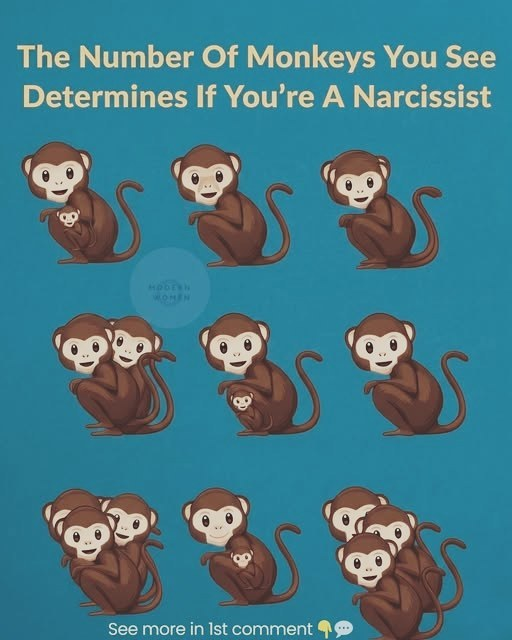
Social media is full of eye-catching puzzles that promise to reveal hidden truths about our personalities. One popular image claims that “the number of monkeys you see determines if you’re a narcissist.” At first glance, it looks like a simple visual challenge, but is there any science behind the claim?
The short answer is no. The image is an optical illusion designed to test observation skills, not diagnose personality traits. However, it does offer an interesting look at how our brains process visual information.
The Monkey Illusion Explained
In the image, several cartoon monkeys are arranged in a grid-like pattern. Some monkeys are obvious and easy to spot, while others are hidden within larger monkey figures. Depending on how carefully you examine the picture, you may notice different numbers of monkeys.
People often report seeing anywhere from 9 to 16 monkeys, depending on whether they count only the larger figures or include the smaller monkeys embedded within them.
This variation occurs because the human brain naturally looks for patterns and familiar shapes. Some viewers focus on the overall image, while others quickly notice smaller details hidden within the design.
Does the Number You See Reveal Narcissism?
Despite what the caption suggests, there is no psychological evidence that the number of monkeys you identify can determine whether you are a narcissist.
Narcissism is a complex personality trait that psychologists evaluate through validated assessments, behavioral patterns, and clinical observation—not through visual puzzles or social media images.
Claims like these are typically created to encourage engagement, spark debate, and motivate users to share the post with friends.
Why People See Different Numbers
Several factors influence how many monkeys a person notices:
1. Attention to Detail
Some individuals naturally focus on fine details and quickly detect hidden elements within an image.
2. Visual Processing Style
People process visual information differently. Some see the “big picture” first, while others immediately notice smaller components.
3. Experience with Puzzles
Those who frequently solve visual riddles and optical illusions often become skilled at spotting concealed objects.
4. Expectations
When viewers are told that there are hidden monkeys to find, they actively search for them, increasing the likelihood of discovering additional figures.
The Psychology Behind Optical Illusions
Optical illusions are fascinating because they reveal how the brain interprets information rather than simply recording it. Our minds constantly make assumptions based on patterns, context, and previous experiences.
Visual puzzles exploit these shortcuts, causing different people to perceive the same image in different ways. This doesn’t indicate a personality disorder; it demonstrates the remarkable flexibility of human perception.
The Real Takeaway
The monkey illusion is a fun brain teaser, but it should be viewed as entertainment rather than a psychological test. Whether you spotted 9 monkeys, 12 monkeys, or every hidden monkey in the image, the result doesn’t determine your personality, intelligence, or mental health.
What it does reveal is something equally interesting: our brains are uniquely wired to interpret the world around us, and even a simple cartoon image can lead different people to see completely different things.
So the next time you encounter a viral image claiming to expose your personality in seconds, enjoy the challenge—but take the conclusion with a healthy dose of skepticism.